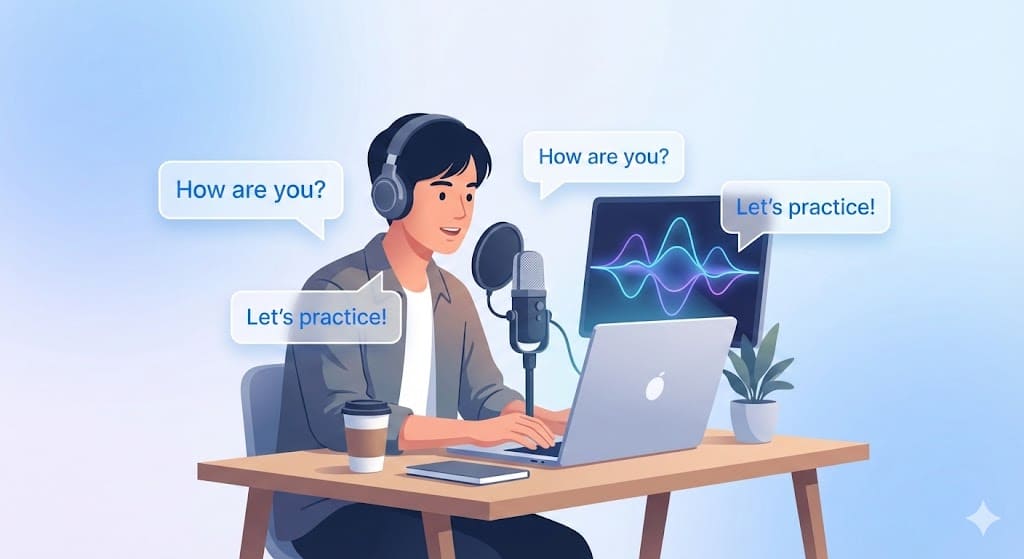
Learning English with AI Voice Chat: A Complete Guide
Can AI voice chat really help you improve your English speaking skills?
Many learners struggle not because they lack vocabulary, but because they are afraid to speak. Fear of making mistakes, fear of being judged, or simply not having anyone to practice with can stop progress completely.
AI voice chat tools create a safe, low-pressure environment where you can practice speaking without embarrassment.
First Time Trying AI Voice Chat: What Does It Feel Like?
Honestly, it feels… different.
Many people carry a long-standing fear of English. That nervous feeling when being called to speak. The racing heart during meetings. Laughing along even when not fully understanding the joke.
Trying AI voice chat for the first time can feel awkward. Speaking English—even to a machine—can make you shy and stiff.
But something interesting happens after a few sessions: your reactions become faster, and your confidence slowly increases.
The Fear of Starting From Scratch
Starting from zero is intimidating.
Hearing English can trigger anxiety, especially if past experiences were uncomfortable. But AI voice chat reduces one important factor: social pressure.
There is no teacher judging you. No classmates watching you. No awkward silence.
That psychological safety is powerful.
Using AI Voice Chat for Daily Speaking Practice
One effective method is using AI voice chat during short daily moments, such as a 15–20 minute commute.
Start simple:
- How are you?
- What did you do today?
- Can you explain this word?
At first, the voice may sound mechanical. The flow may feel unnatural.
But consistency changes everything.
Practicing a little every day builds rhythm and speaking stamina.
Practicing Pronunciation at Home
Not everyone can afford private classes or language centers.
AI voice tools offer an affordable alternative for pronunciation practice.
A simple routine:
- Choose a short topic.
- Speak slowly and clearly.
- Listen carefully to the response.
- Repeat difficult words several times.
- Compare your pronunciation over time.
You may notice gradual improvements:
- Clearer vowel sounds
- Better word stress
- Faster response time
It cannot fully replace a human teacher, but it works well as structured repetition.
Common Mistakes When Studying with AI Voice
Mishearing Words
Audio quality depends on your microphone and environment. Adjust sensitivity and reduce background noise.
Letting the AI Control Everything
If you rely entirely on random prompts, conversations become boring. Choose topics you genuinely care about.
Expecting Emotional Depth
AI still lacks real human emotion. It is helpful for structure and repetition, not for deep emotional connection.
Can AI Voice Chat Replace Real People?
Short answer: No.
Real conversations provide facial expressions, tone shifts, eye contact, and emotional warmth.
However, AI voice chat works well as:
- A safe training ground
- A confidence builder
- A daily practice partner
- A bridge before real conversations
Instead of replacing people, it complements real interaction.
Who Should Use AI Voice Chat?
AI voice chat is especially useful for:
- Beginners afraid to speak
- Busy professionals with limited time
- Students on a tight budget
- Introverted learners who prefer low-pressure practice
It works best as a supplement, not a complete replacement.
Personal Reflection
AI voice chat has clear strengths and weaknesses.
It helps reduce fear. It encourages repetition. It provides accessibility.
But it is easy to become dependent. Skipping practice for a few days can slow progress quickly.
Like most tools, its effectiveness depends on how you use it.
Final Thoughts
Learning English is a journey, not a race.
AI voice chat is not magic. It will not make you fluent overnight.
But used consistently and wisely, it can:
- Build confidence
- Improve pronunciation awareness
- Reduce fear of speaking
- Create daily speaking habits
The most important thing is simple:
Keep speaking.