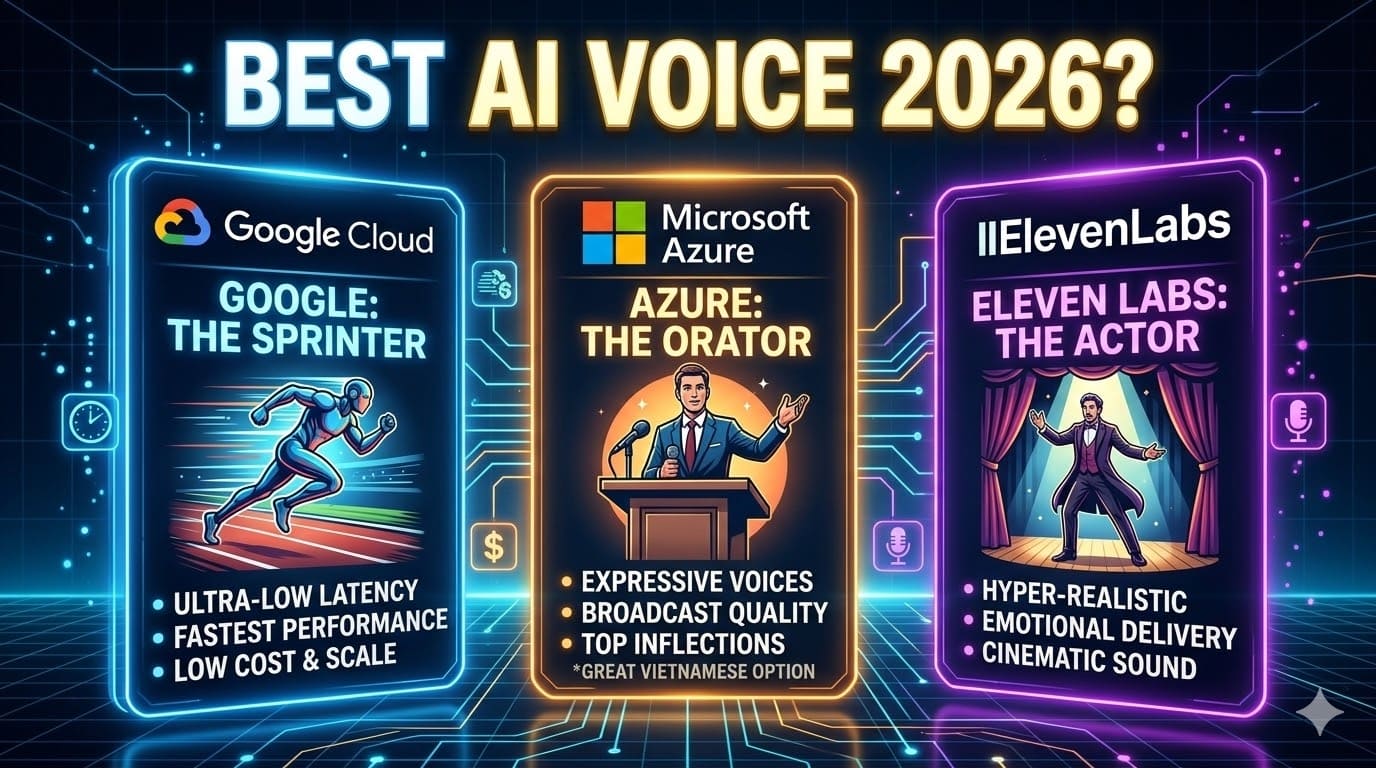
🇺🇸 Google TTS vs Azure TTS vs ElevenLabs: Detailed Comparison (2026 update) – Which Platform Is Best for Your Project?
E-E-A-T: This article is based on real-world integration experience at TTSForFree.com, handling 50,000+ text-to-speech requests per month using Google Cloud TTS, Azure Cognitive Speech, and ElevenLabs in a production environment across English, Vietnamese, and 20+ languages.
Quick Overview
Below is a fast, high-level comparison of the three leading TTS platforms in 2026:
[Try Google TTS Live]
[Listen to Azure, Open AI, Gemini Samples]
| Platform | Strengths | Weaknesses | Best For |
| Google Cloud TTS | Extremely fast, highly stable, easy to scale | Limited speaking styles | Real-time web apps, large-scale systems, document reading |
| Azure Neural TTS | Very natural Neural 2 voices, excellent Vietnamese voices | API setup slightly complex | Video narration, long-form voices |
| ElevenLabs | Most human-like voices, excellent voice cloning | Expensive and slower | TikTok, YouTube, audiobook creators |
## What Changed Since 2025?
- ElevenLabs improved emotional realism but increased pricing
- Azure Neural 2 voices became more expressive, especially Vietnamese
- Google Cloud TTS focused on stability and latency rather than emotion
- OpenAI TTS emerged as a strong option for conversational English
## Where Does OpenAI Text-to-Speech Fit in 2026?
OpenAI TTS focuses on:
- Extremely natural English pronunciation
- Simple API usage
- Strong conversational tone
Limitations:
- Limited language coverage compared to Azure
- Not designed for large-scale batch processing
OpenAI TTS is best for:
- English chatbots
- AI assistants
- Conversational UX
Quick takeaway:
- Real-time apps → Google
- Best Vietnamese voices → Azure
- Highest realism for content creators → ElevenLabs
## Note on Voice Preview Experience
During real-world testing and comparison:
Google Cloud TTS is available for direct audio generation
(using Standard and WaveNet), as it is optimized for quick testing
and real-time web applications.
You can try live voice generation directly on TTSForFree.
For Azure Neural TTS and OpenAI Text-to-Speech,
we provide curated voice samples (previews)
to help users quickly evaluate voice quality,
pronunciation, and naturalness
without complex technical configuration.
These voice previews are also available on TTSForFree.
Voice Quality
Voice quality matters more than speed or pricing, because end users judge your product by how natural the audio sounds.
Google Cloud TTS
Google relies on WaveNet and Neural models.
- Bright, clear, easy-to-understand voices
- Very consistent in long-form text
- Minimal distortion or noise
- Stable even at lower volumes
- Weakness: limited emotional expression
Score: 8.5/10
Best for apps where consistency matters (chatbots, reading tools, telephony).
Azure Neural TTS
Azure’s Neural 2 (n2) voices are among the most natural-sounding in 2026.
- Outstanding Vietnamese voices (MyAn, Mai, Long, NamMinh…)
- Many expressive speaking styles: cheerful, sad, angry, excited
- More emotional variety than Google
- Very strong for long-form narration
Score: 9/10
Azure is ideal if you want broadcast-like, human-sounding voices.
ElevenLabs
ElevenLabs leads the industry in realism.
- Sounds closest to a real human
- Emotion Model with nuanced expression
- Industry-leading voice cloning
- Great for storytelling and characters
Score: 9.8/10
Perfect for content creators who need cinematic-quality narration.
API Speed (Latency)
Measured using 1,000–3,000 characters per request.
| Service | Latency |
| 300–500ms | |
| Azure | 400–700ms |
| ElevenLabs | 800–1500ms |
Why is Google the fastest?
- Massive global infrastructure
- Low connection overhead
- Optimized for real-time TTS
- Stable even under heavy load
🔥 If you're building a real-time TTS website → Google is the #1 choice.
Pricing (2026)
Google Cloud
| Model | Free Tier/month | Price per 1M characters |
| GCP Standard | 4M free | $4 |
| GCP WaveNet | 4M free | $4 |
| GCP Neural2 | 1M free | $16 |
| GCP Polyglot (Preview) | 1M free | $16 |
| GCP Chirp3-HD | 1M free | $30 |
| GCP Studio | 1M free | $160 |
Pricing varies by region and may change. Always verify on official provider pricing pages.
👉 Entry cost starts at $4 per 1M characters
🔵 Azure Neural TTS
- Free tier: 500k characters/month
- Neural voices: ~$15–16 per 1M characters
- Pricing varies by region
🟣 ElevenLabs
- Free: ~10k characters
- Paid: $30–60 per 1M (subscription-based credit model)
- Voice cloning increases cost
🟠 OpenAI TTS (Not character-based)
OpenAI pricing is token-based, not character-based.
Exact pricing depends on model and audio output tokens.
👉 Best positioned for conversational English, not bulk synthesis.
🔶 Gemini TTS (Google LLM TTS)
Token-based pricing:
- Input tokens
- Audio output tokens
Not directly comparable to character-based TTS pricing.
Important notes:
- Google & Azure have limited free tiers (not suitable for production)
- ElevenLabs uses subscription credits → can run out quickly
- ElevenLabs’ cost increases when using cloned voices or long audio
If you want budget + scalability, choose Google or Azure.
If you want quality for videos, choose ElevenLabs.
💰 Real Cost Example (1 Hour of Audio)
1 hour of speech ≈ 50,000–70,000 characters
Estimated cost:
Google WaveNet → ~$0.20–0.30
Google Neural2 → ~$0.80–1.10
Azure Neural → ~$0.80–1.00
ElevenLabs → ~$1.80–3.60
Google Studio → ~$8–11
👉 This shows that large-scale document reading systems can be extremely cost-efficient when using WaveNet or Neural2 models.
Languages & Voices
| Platform | Languages | Voices |
| 50+ | ~1500+ voices | |
| Azure | 140+ | ~400 voices |
| ElevenLabs | 29+ | Unlimited (via cloning) |
Summary
- Azure has the most languages
- Google has the most total voices
- ElevenLabs has unlimited custom voices
Advanced Features
Simple and stable, lightweight features:
- Pitch
- Speaking Rate
- Volume
- Basic SSML
- Very predictable behavior
Focuses on speed + reliability rather than expressiveness.
Azure
Azure is the SSML powerhouse:
- Speaking styles (cheerful, sad, angry, excited)
- Prosody control: pitch, intensity, speed
- Role-playing options
- Whispering
- Precise phoneme control
- Excellent for long-form narration
Azure’s biggest advantage:
👉 flexible, expressive, emotional voices
ElevenLabs
ElevenLabs focuses on content creation:
- Voice Cloning
- Emotion Control
- Multilingual auto-conversion
- Voice Design (create a voice from a text prompt)
- Stability/Similarity sliders
- Ideal for storytelling
If you're making videos, ElevenLabs is in a different league.
Reliability (Uptime & Stability)
Google Cloud
- Nearly zero downtime
- Rarely times out
- Handles heavy load gracefully
- Best for massive scale
Azure
- Very stable, enterprise-grade
- Slight slower response in some regions
- Great for professional applications
ElevenLabs
- Amazing quality
- But slower and may time out during peak load
- Not ideal for large-scale real-time usage
Real-World Integration Experience (E-E-A-T)
From actual usage at TTSForFree:
Google Cloud TTS
- Fastest overall
- Lowest error rate
- Ideal for high-demand systems
- Easiest to scale horizontally
Azure Neural TTS
- Best Vietnamese voices
- Strongest SSML features
- Great for long audio, narration, teaching videos
ElevenLabs
- Most emotionally convincing
- Users love the voice quality
- But not cheap → suited for content creators, not bulk processing
Which One Should You Choose?
1. Building a web or mobile app → Google Cloud TTS
- fastest
- most stable
- cost-effective
2. Need natural Vietnamese voices → Azure Neural TTS
- Neural 2 leading quality
- Many styles
- Great for stories, voiceover, audiobook
3. Creating TikTok/YouTube videos → ElevenLabs
- cinematic realism
- strong emotions
- powerful cloning for brand voice
Try Google WaveNet instantly on TTS For Free
Overall Score Summary
| Criteria | Azure | ElevenLabs | |
| Voice Quality | 8.5 | 9 | 9.8 |
| Vietnamese Voices | 7 | 9.5 | 8 |
| Speed | 9.5 | 9 | 7 |
| Price | 9 | 9 | 6 |
| Advanced Features | 8 | 10 | 10 |
| Reliability | 10 | 9.8 | 8 |
| For Content Creators | 6 | 7 | 10 |