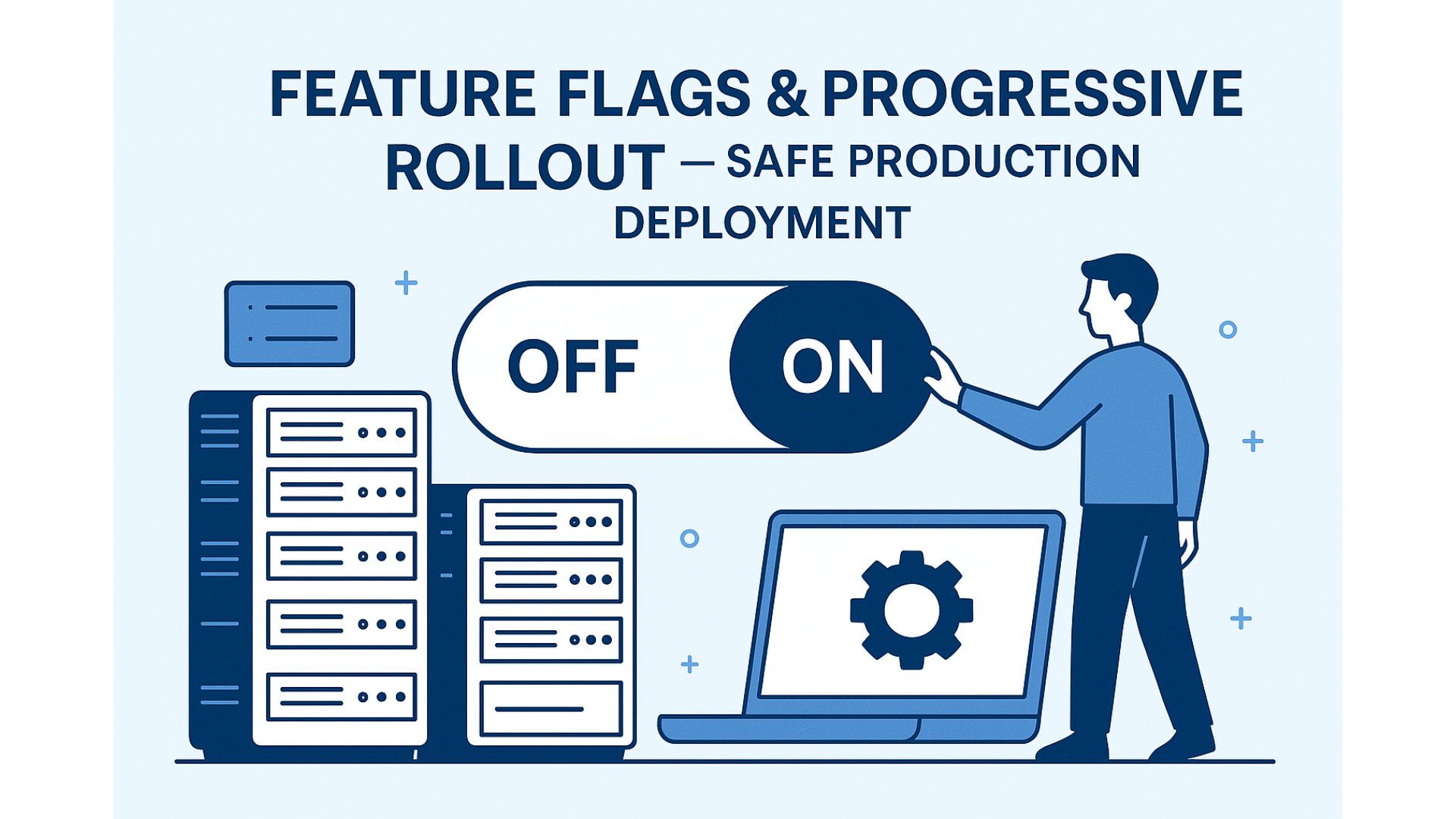
How Companies Deploy New Features to Production Safely (Feature Flag & Progressive Rollout)
Ever wondered how companies push new features to production without breaking everything?
(Or… how they try to avoid breaking everything 😅)
In enterprise systems — especially booking platforms (like the one I work on), finance, banking, or insurance — a new feature always comes with risks:
- Hidden business logic errors
- Unexpected user behavior
- Performance bottlenecks under real traffic
- Or simply… priorities for VIP customers first
That’s why companies rarely release a feature to ALL users at once.
Instead, we roll it out to specific user groups first.
✅ What is a Progressive Rollout by User Segmentation?
A new feature is enabled only for selected users based on:
- Role / Permission
- Admins, internal QA, specific agent levels
- Company / Tenant
- VIP agencies, strategic partners
- User Behavior
- High-transaction users, loyal customers
This reduces blast radius if anything goes wrong and allows us to measure actual usage with real customers.
✅ What needs to be done?
1️⃣ Identify the pilot user group
Pick the most knowledgeable and responsive users:
Internal users + VIP customers
→ Great feedback + better safety
2️⃣ Turn on the feature only for that group
There are two common approaches:
🟦 Approach A — UI controlled by API permissions
- Client calls GetPermissions again
- UI shows/hides components immediately
- No need to force login again
⚠️ Warning:
If UI controls access but API doesn’t validate permissions → huge security risk!
✅ Recommendation:
Critical APIs must verify permissions server-side
🟩 Approach B — Feature Flags (recommended)
- Permission stored dynamically (not only in JWT)
- API can detect feature availability per user instantly
- Enable/disable with configuration only
- Rollback in seconds
This is the standard in DevOps today → Progressive Delivery
3️⃣ Monitor metrics & logs closely
Important signals:
- Error rate
- Latency p95/p99
- Conversion rate (if UI changes)
- Crash logs / user complaints
4️⃣ Collect real user feedback
- Do they navigate smoothly?
- Any confusion or frustration?
- Do they complete the workflow faster?
Real-world usage ≠ internal QA tests
5️⃣ Support instant rollback
Flag OFF = system returns to safe state immediately ✅
No redeploy | No downtime | No hotfix stress
✅ Quick Story Example (Booking System)
🎯 New fast payment flow
👥 Only enabled for VIP agencies first
📊 We monitored success rate for 1 week
✅ If metrics good → rollout to 20% → 50% → 100%
⛔ If errors spike → disable flag instantly
Simple. Safe. Smart.
✅ Final Thought
Rolling out features by user segment isn’t about caution — it’s about being smart.
Test safely. Learn early. Scale confidently.
This approach helps teams:
- Protect revenue-critical systems
- Improve product decisions with real data
- Ship faster with lower risk
- → Deploy like a pro 💪
Have you ever faced a production disaster after launching a new feature?
What rollout strategy saved your team?
Share your story below! 👇